There is a version of AI agents that sounds great in demos and a bit useless in real life: run my life, book my holidays, organise everything.
I wanted something more practical. Something that could sit inside my own setup, talk to the services I already use, run scheduled jobs, call APIs, and nudge me when something needed a human decision.
That is what Hermes Agent has become for me. Not a chatbot. More like a small operator.
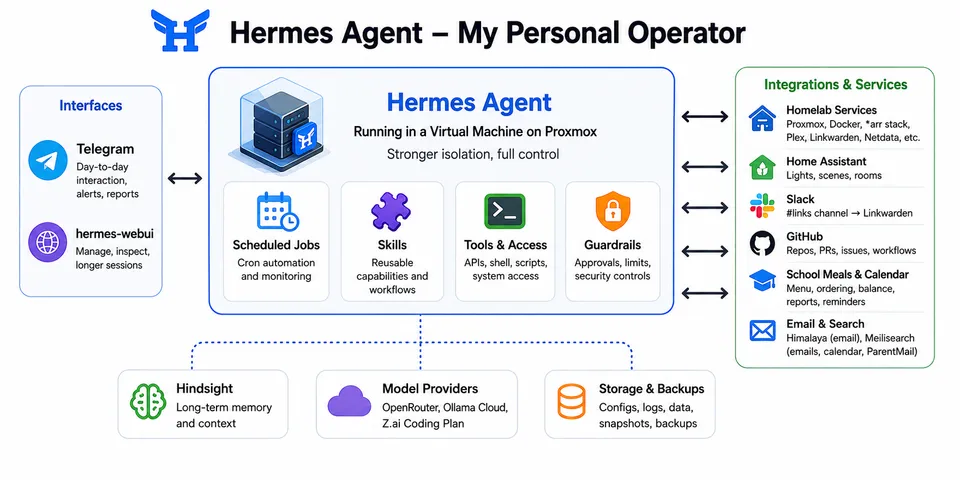
The shape of the setup
Hermes runs in a Proxmox VM. I wanted stronger isolation than a container for something that can run real commands.
I mostly talk to it through Telegram for everyday requests, and use the web UI for longer sessions. Hindsight handles long-term memory, so Hermes does not treat every session as a blank slate. Models come from providers such as OpenRouter, Ollama Cloud and Z.ai, depending on whether the job needs a frontier model, a cheap background run, or something better suited to coding.
The useful bit is not any single part. It is that everything is reachable through one operator-style interface.
Why Hermes rather than OpenClaw
OpenClaw is the obvious comparison, and it is probably a great fit for many people. For me, the difference was shape and posture. OpenClaw feels like a broad personal assistant platform. Hermes felt closer to infrastructure: a long-running operator inside my homelab.
Security mattered too. Any agent that can run commands needs caution, and Hermes has had vulnerabilities of its own. But its security model is clear about being a single-operator personal agent, with layered controls around dangerous commands, credentials and context.
OpenClaw’s public CVE picture has been noisier, including a recent high-severity CVEs. Neither project is “safe” in any absolute sense. But I am giving this thing limited access to real systems, so the risk calculation matters.
The boring jobs that quietly save time
The most useful Hermes jobs are not impressive on their own. Backing up config. Checking server health. Cleaning up dead torrents. Watching for hardware deals. Sending a daily news digest. Archiving Slack links into Linkwarden.
None of these is revolutionary by itself. Together, they remove a lot of background friction. And unlike a chatbot, Hermes does not just answer once. It runs the same useful process every day, every week, or every hour.
School meals are the clearest example
Hermes checks the available meals, takes the kids’ preferences into account, and orders automatically. If there are not enough funds, it tells us. It also adds a calendar reminder, so the alert does not just get forgotten.
The only missing piece is payment. I have not given it a card. That is a deliberate boundary. But it is easy to imagine a dedicated Revolut card with a tight balance and locked-down merchant use, making this almost fully automated while keeping the blast radius small.
This is the kind of workflow that makes agents useful in real life. Not because it is glamorous, but because it turns a recurring bit of family admin into something that mostly looks after itself.
Homelab work is where the operator model shines
I can ask a normal question, but Hermes can also inspect the system, run commands, read logs, change config, test the result, and document what it did.
That is far more useful than a generic answer about how something should work. It becomes a working session with an assistant that can actually touch the environment.
Coding, research and capture
Hermes works alongside GitHub, helps shape coding tasks, and coordinates other agents, including coding tools such as opencode. I want a small team of tools with different strengths, wrapped in an operator layer. Not one giant agent doing everything.
It is also good at slow, repetitive research: comparing car hire, monitoring deals, summarising YouTube transcripts, filtering travel options. I still make the decision. Hermes does the trawling.
Link capture turns out to matter too. Drop a URL into Slack, and Hermes saves it to Linkwarden, tags it, and makes it searchable. Messy inputs become searchable outputs. That is the win.
Skills are where the value builds
A one-off prompt is disposable. A skill is reusable.
Once a workflow is captured, Hermes has a known way to do the job. It does not need to work it out again each time.
Some of mine are tiny. One tells Hermes to consult a stronger frontier model when a task calls for it. Another nudges it to search the web before answering from training data.
That second one matters more than it sounds. A lot of bad AI answers are not bad because the model is stupid. They are bad because the model confidently answers from stale training data when it should have checked.
The difference from just using ChatGPT
ChatGPT can tell me how to write a cron job. Hermes can run it, store the config, send the output to Telegram, and tell me when it fails.
ChatGPT can explain how to organise bookmarks. Hermes can watch a Slack channel and do it.
ChatGPT can suggest how to manage school meals. Hermes can check the menu, place the orders, warn when funds are low, and add a reminder.
The model is not magically smarter. It has tools, memory, access, schedule and context.
The boundaries still matter
The more capable the agent becomes, the more the rules around it matter.
Run it somewhere isolated. Use narrow credentials where possible. Keep sensitive actions behind confirmation. Log important actions. Assume prompt injection is always possible. Treat third-party skills like untrusted code.
An agent that only chats can be wrong. An agent that runs commands can be wrong and break things. That changes the standard.
The real lesson
Agents become useful when they stop being generic.
Not because they become conscious or understand your life in some mystical way, but because the useful workflows become explicit. The agent learns where things are, which services matter, which alerts are noise, which jobs repeat, and which actions need approval.
That is where the value is. Not one amazing prompt. A growing pile of small, specific, boring capabilities.
For me, that is much more interesting than autonomy.